

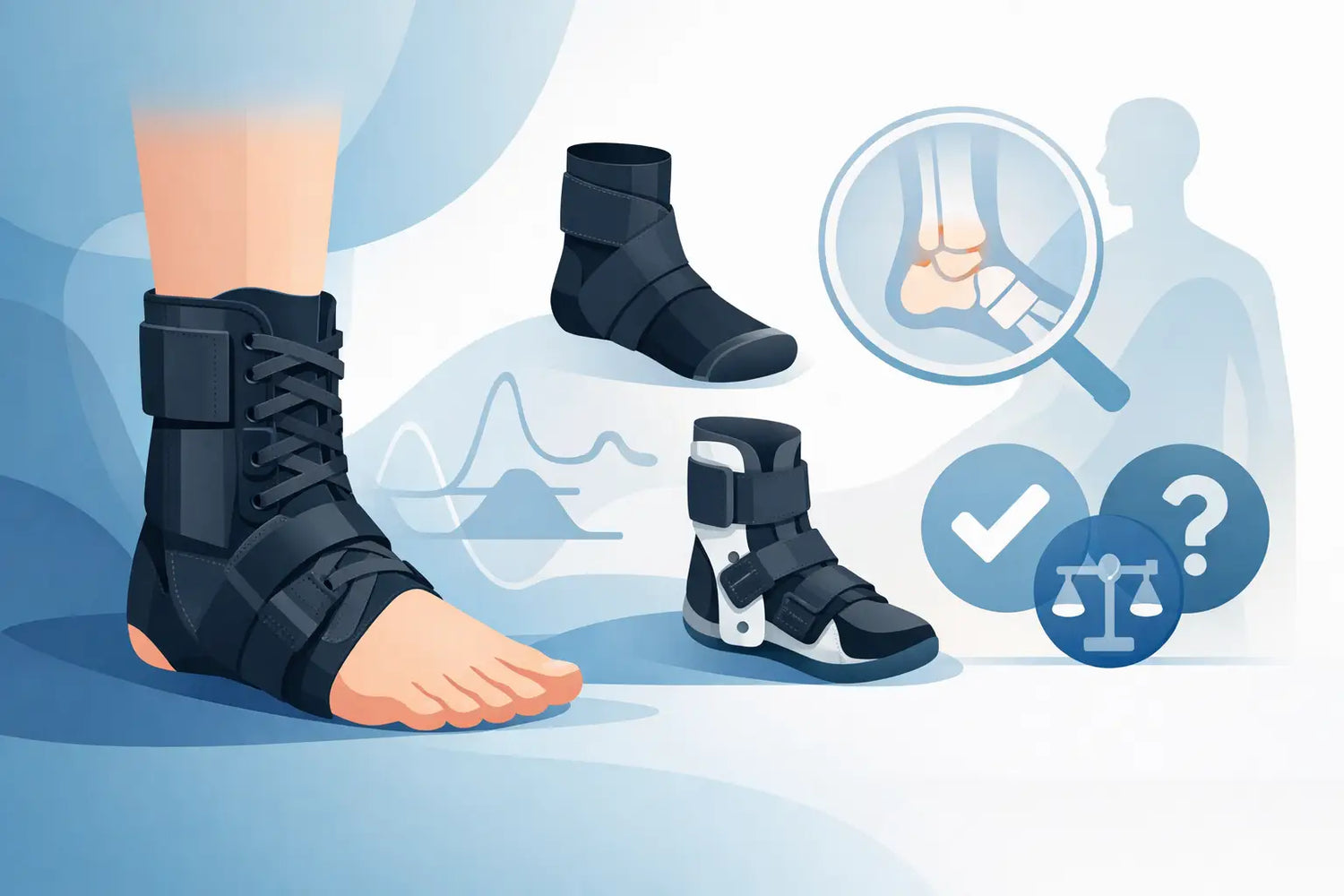
A single misstep off a curb, a turn on an uneven trail, or a familiar feeling that the ankle may give way can change how confidently you move. An ankle brace for instability is designed to provide more than warmth or light compression: it can help guide the joint, limit unwanted motion and support a safer return to daily activity, work or sport.
The right support depends on why the ankle feels unstable. A recent lateral ankle sprain, ongoing ligament laxity, reduced proprioception after injury, arthritis-related changes and post-treatment rehabilitation can all create a sense of weakness or unreliability. The best brace is not necessarily the most rigid option. It is the one that provides an appropriate level of stabilization while allowing you to move comfortably and follow your care plan.
What ankle instability can feel like
Ankle instability is often described as the ankle “rolling” easily or feeling as though it may buckle during walking, stairs, quick direction changes or uneven ground. For some people, it follows one significant sprain. For others, repeated sprains gradually stretch or damage the supporting ligaments, particularly on the outside of the ankle.
Symptoms can vary. You may notice recurring swelling after activity, tenderness around the outer ankle, hesitation when walking on uneven surfaces, or reduced confidence when returning to sport. Chronic ankle instability may also affect how you load the knee, hip and lower back as you subconsciously try to protect the joint.
A brace can be a useful component of management, but it does not replace assessment when symptoms are new, severe or persistent. Seek timely medical attention for inability to bear weight, marked swelling or deformity, numbness, worsening pain, or suspected fracture. A physician, physiotherapist or other qualified practitioner can help determine whether bracing, rehabilitation, imaging or another treatment approach is appropriate.
How an ankle brace for instability works
A stabilization brace works through a combination of mechanical support and sensory feedback. Its structure may help resist excessive inversion, the inward rolling movement commonly associated with lateral ankle sprains. Compression can help manage mild swelling and improve awareness of the ankle’s position during movement.
The level of support comes from the brace architecture. Some designs use knitted compression fabric with integrated support zones. Others add straps that wrap around the ankle in a figure-eight pattern, reinforcing the ligament area. More structured braces may include rigid or semi-rigid side elements to control side-to-side movement more firmly.
No design should make walking feel forced or painful. Effective stabilization is a balance: enough control to protect a vulnerable ankle, with sufficient mobility for the activity and stage of recovery. A brace that is overly restrictive for your needs may be uncomfortable in footwear and discourage consistent use. One that is too light may not provide meaningful confidence or support.
Match the support level to your needs
Mild support for early symptoms and everyday confidence
A compression ankle support may suit mild feelings of instability, minor swelling, fatigue during long periods of standing or a gradual return to regular activity. These supports are usually lower profile and may fit more easily into a work shoe or athletic shoe.
This category can be useful when the goal is proprioceptive support and gentle compression rather than firm motion control. It may also be appropriate for people who need a comfortable support for day-to-day use after they have progressed beyond the acute phase of an injury.
Functional stabilization after a sprain
For a recovering sprain or recurrent rolling episodes, a brace with adjustable straps or reinforced stabilization zones can offer more targeted support. The straps are designed to help control unwanted side-to-side movement while still allowing functional walking and ankle flexion.
This is often the practical middle ground for active adults. It can support a return to walking, gym training, recreational sport or physically demanding work while rehabilitation continues. The exact timing of return to activity should follow the advice of your treating practitioner, particularly after a more significant injury.
Firm support for significant ligament weakness
Semi-rigid ankle braces are generally considered when a higher degree of protection is needed, such as during the early phase after a substantial sprain or with pronounced chronic instability. Their lateral shells, stays or stabilizing elements can offer stronger resistance to inversion and eversion.
Greater control has trade-offs. A structured brace may require more room in a shoe and can feel less natural during certain activities. It should also be fitted carefully. If a brace creates pressure points, altered circulation, tingling or numbness, remove it and consult your practitioner or product provider.
Features that matter in a stabilization brace
When comparing an ankle brace, look beyond the general label of “support.” Consider how the product is built and how it will work with your routine.
Compression level matters when swelling, tissue sensitivity or prolonged standing are part of the picture. Medical-grade compression should feel supportive and even, not constrictive. Knitted materials with anatomically shaped zones can reduce bunching around the heel and ankle crease, which is especially relevant for all-day wear.
Stabilization features determine how much control the brace can offer. Integrated straps, reinforced side zones and rigid side supports are designed for different levels of instability. A lace-up or strap-based model may offer useful adjustability when swelling changes through the day, while a pull-on compression support may be faster and more discreet to apply.
Comfort is a clinical consideration, not a luxury. A brace needs to work inside your footwear and against your skin. Look for breathable materials, low-profile construction, smooth edges and a heel design that stays properly positioned. If you will wear it at work, test it with the footwear you actually use, including safety footwear where applicable.
Sizing is part of treatment effectiveness
An ankle brace can only perform as intended when it fits correctly. A loose brace may migrate, wrinkle or provide inconsistent stabilization. An overly tight brace can cause discomfort and may impair circulation.
Use the manufacturer’s measurement instructions rather than choosing by shoe size alone. Depending on the design, sizing may require ankle circumference, heel-to-instep measurement or both. Measure at the specified locations, ideally when swelling is at its usual level. If your measurement falls between sizes, the product guidance and your practitioner’s recommendation should guide the decision.
Put the brace on according to its instructions, with the heel seated fully in the heel opening or cup before tightening straps. The support should feel secure, with no pinching at the front of the ankle or pressure against the ankle bones. Recheck strap tension after a few minutes of walking.
Bracing works best alongside rehabilitation
A brace can protect and support the ankle, but long-term stability also relies on strength, balance, range of motion and neuromuscular control. This is why practitioners frequently pair bracing with a progressive rehabilitation program.
Early exercises may focus on restoring comfortable movement and reducing swelling. As symptoms settle, rehabilitation often progresses to calf and ankle strengthening, single-leg balance work, controlled stepping and sport- or work-specific movements. The goal is not simply to remove the brace as quickly as possible. It is to return to activity with a joint that is better prepared for the demands placed on it.
For recurrent instability, wearing a brace during higher-risk activities may remain sensible even after everyday walking is comfortable. Trail running, court sports, field sports and uneven work sites all place different demands on the ankle. Your practitioner can help you decide when support is beneficial and when it may no longer be needed.
Practical considerations for Canadian customers
For an injury connected to an insurance or extended health benefits claim, keep your physician prescription and purchase documentation. Many plans have specific requirements for orthopedic braces, and reimbursement eligibility varies by insurer and policy. Confirm the documentation requirements before ordering if coverage is a deciding factor.
Quality also matters when a brace will be used repeatedly through rehabilitation and daily life. Sporlastic Canada focuses on clinically informed, German-engineered orthopedic supports designed to provide purposeful stabilization, compression and fit. For the most appropriate option, compare the indicated conditions, support architecture and sizing instructions rather than selecting a brace based on appearance alone.
A well-chosen ankle brace should make movement feel more controlled, not more complicated. When the support level, fit and rehabilitation plan work together, each walk, shift and return to activity can become a more confident step forward.


Leave a comment
This site is protected by hCaptcha and the hCaptcha Privacy Policy and Terms of Service apply.