

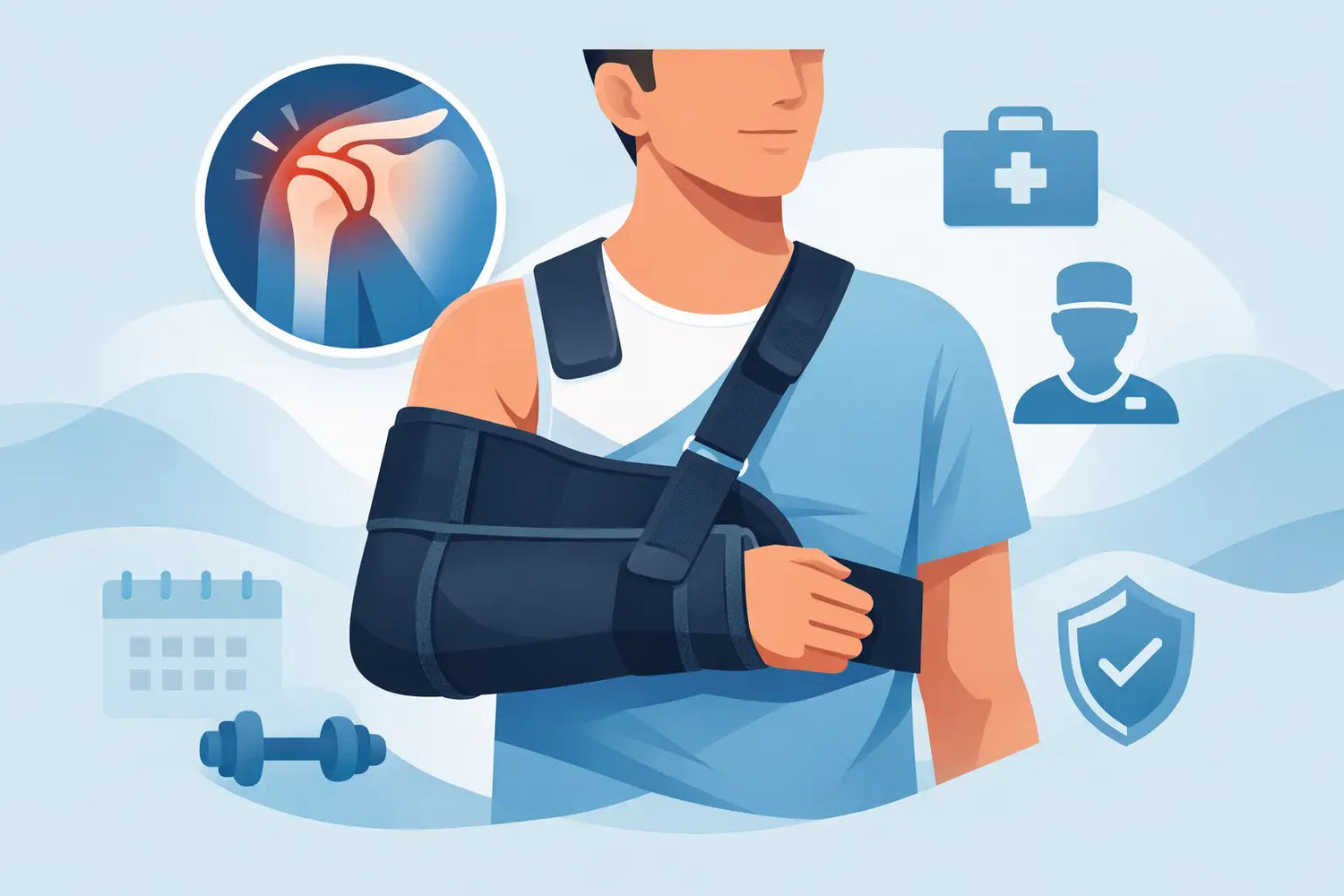
A shoulder that has dislocated needs more than a period of rest. After the joint has been reduced by a qualified medical professional, a shoulder brace after dislocation can help limit vulnerable movements while the capsule, ligaments, muscles, and surrounding tissues begin to recover. The right support is not simply about holding the arm still. It should match the type of injury, your stage of healing, your comfort needs, and the treatment plan provided by your physician or therapist.
A dislocation can occur during sport, a fall, a workplace incident, or an everyday movement when the shoulder is already unstable. Because the shoulder is designed for a wide range of motion, it relies heavily on soft tissues for control. That mobility is useful, but it also means a previous dislocation can increase the risk of another episode, particularly in active people and younger patients.
First: a dislocation requires medical assessment
A shoulder that appears dislocated should be assessed urgently. Do not try to force it back into place yourself. Reduction should be performed by a trained clinician, who can assess circulation, nerve function, associated fractures, and soft-tissue damage.
Seek urgent care if the shoulder looks visibly out of place, pain is severe, the arm is numb or weak, the hand is cold or pale, or you cannot move the arm after an injury. Even after the joint has been put back in place, follow-up matters. Imaging, a physical examination, or referral to an orthopedic specialist may be needed to identify injuries such as a labral tear, rotator cuff injury, fracture, or nerve involvement.
A brace supports recovery after assessment. It does not replace reduction, diagnostic care, or a rehabilitation plan.
What a shoulder brace after dislocation is designed to do
In the early stage, the main purpose of a shoulder support is controlled protection. An immobilizing shoulder brace or sling can keep the upper arm close to the body and reduce movements that may be painful or place stress on healing tissues. Depending on the design, it may support the forearm, secure the arm against the torso, and distribute weight comfortably across the shoulder and trunk.
This can make practical tasks more manageable during the first days or weeks. Walking, commuting, sleeping, and moving through a busy workplace can all feel less concerning when the arm is properly supported. A well-fitted brace can also provide a useful reminder not to reach suddenly, lift, or move into positions that your clinician has asked you to avoid.
Later, as directed by a physician or physiotherapist, the focus often changes. Full immobilization may no longer be appropriate once guided movement and muscle activation are needed. At that point, some patients transition away from a sling, while others may use a stabilizing support for specific activities or periods of increased demand. The exact approach depends on the injury and the person, not simply the number of days since the dislocation.
Immobilization and stabilization are not the same
An immobilizer is typically used during the acute protective phase. It limits shoulder motion more substantially and supports the arm's weight. This may be appropriate immediately after a first-time dislocation or when pain and tissue injury are significant.
A stabilizing shoulder brace may allow more movement while offering targeted support, compression, or proprioceptive feedback. It can be considered in later rehabilitation or for recurrent instability, but only when movement restrictions and activity goals make that type of support suitable.
Choosing too little support can leave the shoulder vulnerable during the early phase. Choosing too much support for too long can contribute to stiffness, weakness, and delayed return of function. This is why a clinician's recommendation should guide both the brace category and the wearing schedule.
How long should you wear a shoulder brace?
There is no universal timeline. Some people are advised to use a sling or immobilizer briefly, while others require a longer protection period because of age, associated injury, surgery, recurrent instability, or the physical demands of work and sport. Your treating professional may also specify whether the brace should be worn continuously, removed for hygiene, or taken off for prescribed exercises.
Do not stop wearing a prescribed brace early because the shoulder feels better for a day or two. Pain can settle before the joint has regained reliable stability. Equally, do not continue immobilization beyond the recommended period without advice. Stiffness can develop quickly in the shoulder, particularly in older adults and in people who have had prior shoulder problems.
Your plan should answer practical questions clearly: whether to sleep in the brace, whether it can be removed to shower, when you may drive, and which movements remain restricted. Driving is generally not appropriate while the arm is immobilized or when pain, limited motion, or medication could affect safe vehicle control.
Features that make a brace more effective to wear
A shoulder brace only helps if it is positioned correctly and tolerable enough to use as prescribed. Purposeful design matters, particularly when the support is worn for several hours at a time.
Look for an adjustable system that can hold the arm in the position recommended by your clinician without pulling the neck or allowing the elbow to drift backward. A forearm cradle or supportive sling section should carry the arm's weight rather than concentrating pressure at one point. Broad, padded straps can improve comfort and reduce pressure across the neck and opposite shoulder.
Breathable materials are useful for day-to-day wear, especially under indoor clothing or during warmer Canadian weather. Secure closures should be manageable with one hand where possible. For patients with reduced hand function, arthritis, or postoperative restrictions, ease of application is more than a convenience feature - it can affect whether the brace is used correctly.
Sizing should be based on the manufacturer's measurements, not on a usual clothing size. A brace that is too loose may allow the arm to shift; one that is too tight can cause rubbing, hand swelling, altered sensation, or discomfort. Check that straps lie flat, the elbow is well supported, and the hand remains warm with normal colour and sensation.
Wearing the brace without creating new problems
A clinician or trained fitter should show you how to apply the support. Small adjustments can make a meaningful difference. The elbow should usually sit well back in the sling pocket, with the forearm supported and the wrist in a neutral, comfortable position. Unless instructed otherwise, avoid allowing the hand to hang below the elbow for long periods, as this can contribute to swelling.
Keep the skin under straps clean and dry. A thin, smooth layer of clothing beneath the brace may reduce friction if permitted by your provider. Regularly inspect the neck, elbow, and strap contact points for redness or skin irritation.
Contact your healthcare provider promptly if pain increases rather than gradually improves, the shoulder feels as though it is slipping out again, or you develop new numbness, tingling, weakness, marked swelling, colour changes, fever, or skin breakdown. These symptoms need assessment rather than a tighter strap adjustment.
Rehabilitation is where stability is rebuilt
A brace protects the shoulder, but it cannot restore joint control on its own. Recovery usually progresses from protection to guided range-of-motion work, then strengthening and functional training. The rotator cuff, shoulder blade muscles, and trunk all contribute to keeping the upper arm centred in the joint during reaching, lifting, and sport.
Physiotherapy may be particularly valuable after a first dislocation, recurrent instability, or an injury linked to sport or physical work. A tailored program helps restore motion without forcing painful end ranges too soon. It also addresses the movements and positions that matter in your daily life, whether that means reaching overhead at work, carrying equipment, returning to hockey, or simply dressing without apprehension.
For recurrent dislocations, a brace may be one part of a broader care plan. Some people respond well to rehabilitation and activity modification, while others require specialist assessment for structural instability. A support should never be used to push through repeated giving-way episodes.
Choosing support with your treatment plan in mind
When selecting a shoulder support, bring the recommendation from your physician, physiotherapist, chiropractor, occupational therapist, or orthopedic specialist. It is helpful to know whether you need immobilization, activity-specific stabilization, compression, or postoperative positioning. If you are submitting through extended health insurance, keep your prescription and product documentation, as many plans require these records for reimbursement.
Premium orthopedic supports are designed around fit, skin comfort, adjustability, and purposeful stabilization rather than generic one-size-fits-all restraint. At Sporlastic Canada, the most appropriate category begins with the clinical need: protect a recently reduced shoulder, support a staged return to movement, or manage a known pattern of instability under professional guidance.
The useful question is not simply, "Do I need a brace?" It is, "What movement needs protection right now, and what will help me progress safely to the next stage of recovery?" A properly selected brace, combined with follow-up care and gradual rehabilitation, gives the shoulder the conditions it needs to regain confidence in motion.


Leave a comment
This site is protected by hCaptcha and the hCaptcha Privacy Policy and Terms of Service apply.