

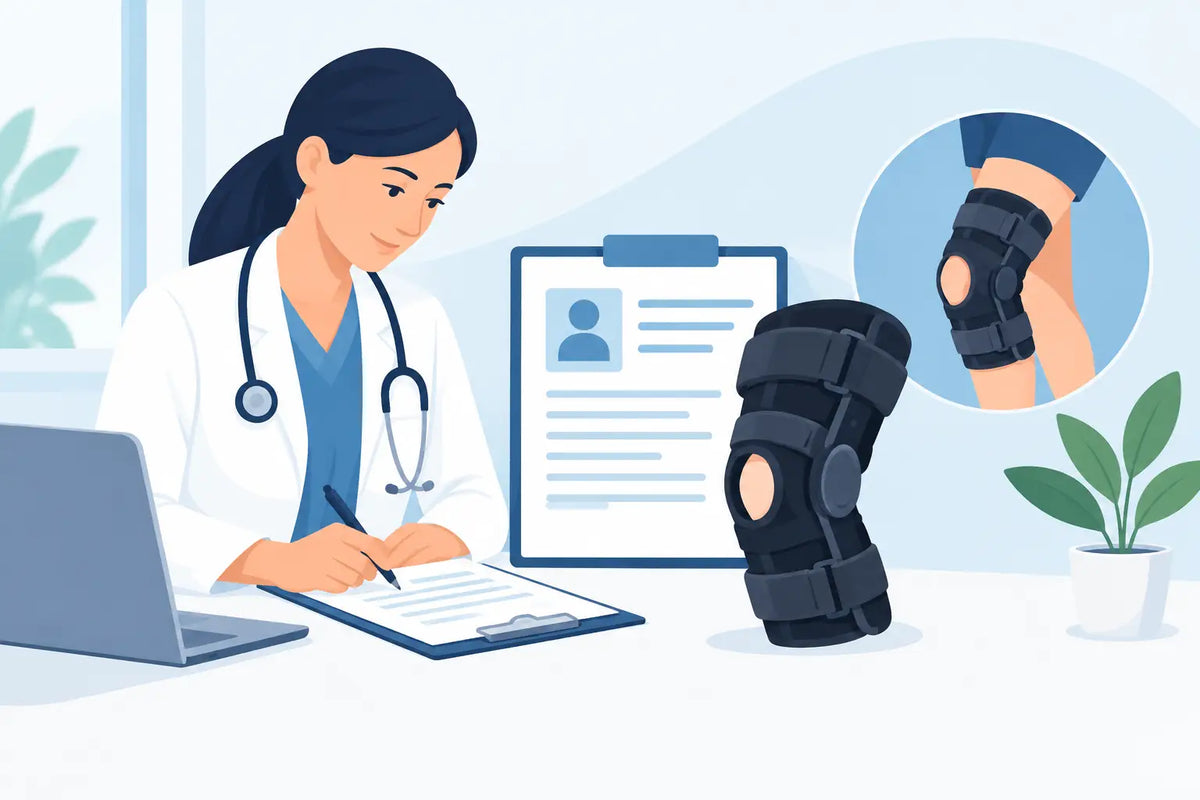
A brace can be clinically appropriate and still be difficult to claim if the paperwork is vague, incomplete, or submitted after key information has been lost. This prescription documentation guide explains what Canadian customers and health practitioners should prepare when an orthopedic brace, compression support, or stabilization product may be submitted for extended health benefits.
The first principle is simple: a prescription supports a treatment decision, while the receipt supports a purchase. Many insurance plans require both. Requirements vary by insurer, policy, province, benefit category, and the type of support being purchased, so approval cannot be assumed. Preparing clear documentation before ordering helps avoid delays and gives the insurer a better picture of why the product was recommended.
Start with your benefit plan, not the product page
Before purchasing a knee brace, ankle support, back orthosis, wrist brace, or compression garment, review your extended health plan. Look specifically for terms such as orthotics, orthopedic braces, medical equipment, compression garments, or durable medical equipment. Some plans cover only specific categories, require a physician's prescription, limit reimbursement to a fixed annual amount, or ask for pre-authorization above a certain value.
A product that is useful for day-to-day comfort is not automatically eligible for reimbursement. Insurers commonly distinguish between a general athletic accessory and a medical support intended for a diagnosed condition, injury, post-operative recovery, or functional instability. Product design, stated indication, and the wording on the prescription can all affect how the claim is assessed.
If your plan booklet is unclear, contact the insurer before ordering. Ask whether the item requires a prescription, whether a referral is needed, whether a quote is accepted for pre-approval, and whether the provider must meet any particular credential or registration requirement. Keep a note of the date, representative's name, and reference number if one is provided.
What a clear prescription should include
A prescription should connect the patient's condition to the recommended support. A brief note that says “brace” may not give an insurer enough information to determine medical necessity. The prescriber should use their clinical judgment and document only what is relevant, but clarity is valuable.
In most cases, the prescription should identify the patient, include the date, and show the prescriber's name, professional designation, signature, and contact information. It should also state the body area and the type of support required. For example, “functional knee brace,” “lumbar support orthosis,” or “medical-grade compression stockings” is more useful than a generic request for support.
The clinical reason should be specific enough to explain the recommendation. Depending on the situation, this may refer to ligament laxity, ankle instability, meniscal injury, osteoarthritis, wrist tendinopathy, post-operative protection, edema, or another diagnosed musculoskeletal concern. A diagnosis code is not always required, but it can help when the insurer requests one.
The prescription does not always need to name a particular brand or model. In fact, a category-based prescription can be more practical when fit, sizing, compression level, laterality, or the patient's functional needs must be confirmed. A clinician may specify features that matter, such as a hinged knee brace, a rigid thumb orthosis, adjustable lumbar stabilization, or compression in a particular range.
Details that reduce questions later
Laterality matters. If the support is for the left knee, right wrist, or both ankles, include that information. Insurers may also need the quantity, especially for paired items or compression garments where more than one unit is medically indicated.
For a prescribed brace, the wording should align with the purchased product. A prescription for a soft sleeve may not support a claim for a more structured hinged brace, while a broad recommendation for a medically necessary knee orthosis may allow appropriate product selection. When there is uncertainty, ask the prescriber or insurer before placing the order rather than trying to adjust documentation afterward.
Match the support to the documented treatment need
Orthopedic supports are not interchangeable. The right choice depends on the affected joint or region, the level of instability, the stage of recovery, daily activity demands, and the treatment plan. Compression can assist with proprioception and swelling management, while straps, stays, hinges, and anatomically shaped knit construction may provide greater guidance or stabilization.
Consider a person returning to work after an ankle sprain. A compressive ankle support may be appropriate for mild residual swelling and confidence during movement. If there is ongoing ligament instability, a more structured ankle orthosis may be clinically indicated. The prescription and product selection should reflect that distinction.
The same approach applies to knee supports. A knit support can be suitable for mild discomfort or patellar guidance, whereas a brace with side supports or hinges may be recommended for ligament-related instability, meniscal concerns, or controlled return to activity. More support is not automatically better. A brace that is overly restrictive for the treatment goal can be uncomfortable, difficult to wear consistently, or inappropriate for the activity.
Product documentation can help confirm features, intended use, material composition, and care instructions. Save a copy of the product description or invoice details when available, particularly if the insurer later asks for evidence of what was purchased. Sporlastic Canada provides product information designed to help customers and practitioners compare clinically relevant support features before ordering.
Keep the purchase record complete
Once you purchase the product, retain the final itemized receipt. The receipt should show the supplier's name, purchase date, product name or clear description, quantity, amount paid, and applicable taxes. A payment confirmation alone may not satisfy an insurer because it may not identify the medical item.
Keep the original prescription with the receipt, even when uploading digital copies to a claim portal. Scan or photograph documents in good light, ensuring every edge is visible and all text is readable. File names such as “Knee_Brace_Prescription” and “Knee_Brace_Receipt” make future follow-up much easier.
If an insurer requests additional information, respond with the exact document requested rather than sending unrelated medical records. Your diagnosis and treatment details are personal health information. Share only what is necessary for the claim, using the insurer's approved submission method.
Guidance for clinics and health practitioners
For practitioners, documentation is part of continuity of care. A well-written prescription helps the patient obtain an appropriate device and supports communication among the prescriber, fitter, supplier, insurer, and rehabilitation team.
Avoid promising coverage. Even when a brace is clinically indicated, the insurer determines eligibility under the patient's individual policy. Instead, explain that reimbursement may depend on the plan's rules and that the patient should verify requirements before purchase.
When recommending a support, document the treatment objective in the clinical record. This could be pain modulation, edema management, joint guidance, ligament protection, post-treatment support, improved function during work tasks, or graded return to sport. If the patient is being referred for fitting or product selection, note relevant factors such as circumference measurements, sensitivity concerns, restricted hand function, skin integrity, or the need for bilateral support.
For more specialized braces, fitting is not a minor detail. Correct sizing affects both comfort and performance. A device that migrates, pinches, or limits circulation may not deliver the intended support. Encourage patients to follow measurement instructions carefully and to seek help promptly if fit or symptoms are concerning.
Common claim problems and practical fixes
The most frequent issue is a missing prescription. If your insurer requires one, obtaining it after purchase may not be accepted, especially when the document is dated after the invoice. Check this requirement first.
Another issue is an unclear prescription that does not identify the body area or device category. In that case, ask the prescriber whether they can provide an amended note that accurately clarifies the original clinical recommendation. Do not alter the document yourself.
Customers also run into trouble when the receipt names only a broad product category. Request an itemized invoice if available. Finally, submit within your plan's claims deadline. A valid prescription and receipt may still be declined if the claim arrives too late.
A clear prescription, an appropriate product, and a complete receipt create a straightforward record of care. Taking a few minutes to organize those documents before you order can keep the focus where it belongs: comfortable movement, protected recovery, and the confidence to return to the activities that matter to you.

Leave a comment
This site is protected by hCaptcha and the hCaptcha Privacy Policy and Terms of Service apply.