

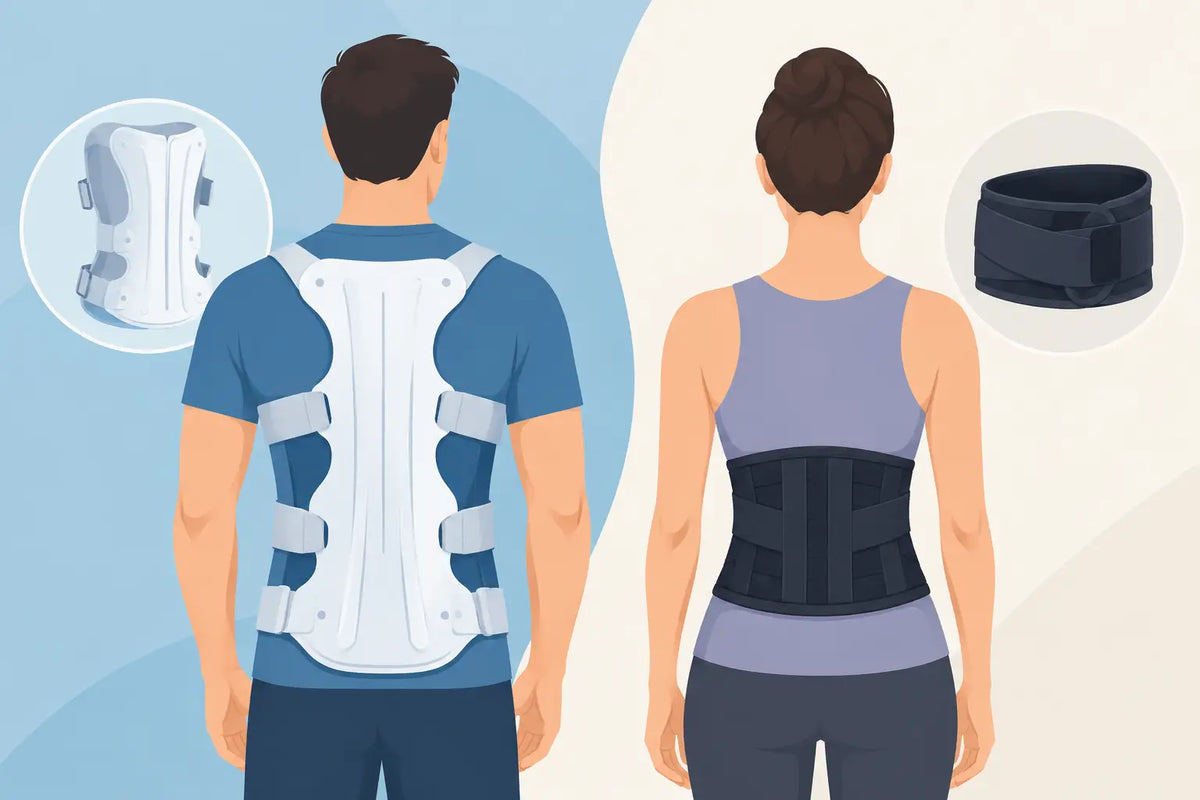
A back brace should do more than make the area feel held. When comparing rigid versus soft back braces, the useful question is not simply which one offers more support. It is which type of support matches the diagnosis, stage of recovery, daily demands and treatment plan.
A soft brace can provide compression, warmth and movement guidance during work, walking or rehabilitation. A rigid brace can limit specific spinal motions more substantially when protection is required. Choosing incorrectly may leave you under-supported, but choosing the most restrictive option without a clinical reason can also make daily activity unnecessarily difficult.
Rigid Versus Soft Back Braces: The Core Difference
Soft back braces are generally made from elastic or inelastic textiles, often with compression panels, adjustable straps and flexible stays. They are designed to contour to the body while providing circumferential support around the lumbar spine and abdomen. Their effect comes from compression, improved body awareness and controlled tension around the trunk.
Rigid back braces use firmer structural components, such as reinforced posterior panels, moulded shells or rigid stays. Depending on the design, they may restrict bending, twisting or extension more significantly. Some are prescribed after surgery, vertebral fracture or a condition that requires a clearly defined limit on spinal movement.
There is also a middle category. Semi-rigid braces combine supportive textile construction with stronger stays, tension systems or removable rigid inserts. For many people, this is the practical bridge between a flexible lumbar support and a highly restrictive orthosis.
The distinction matters because a brace is a treatment tool, not simply a garment. Its architecture should serve a purpose: reducing painful movement, supporting a return to activity, helping a patient tolerate rehabilitation or protecting healing structures.
When a Soft Back Brace May Be Appropriate
A soft lumbar brace is often considered when the goal is manageable support during everyday movement rather than strict immobilization. It may be appropriate for non-specific low back pain, mild to moderate muscle strain, recurrent discomfort during physically demanding work, or degenerative changes that make standing and walking difficult.
Compression is central to how many soft braces work. Gentle, well-distributed pressure can improve proprioception - the body's awareness of position and movement. This may encourage more controlled posture and reduce the sense of instability that can accompany low back pain. Adjustable straps allow the user to increase support for a demanding task, then reduce tension when seated or resting.
A soft brace can also be useful during the transition back to normal activity. For example, someone recovering from a lumbar strain may use it for short periods while returning to warehouse duties, gardening or longer car journeys. An active adult with occasional flare-ups may use support for a planned activity that reliably aggravates symptoms, while continuing with a physiotherapy-directed strengthening program.
That does not mean soft braces are only for minor concerns. The appropriate level of support depends on the clinical picture. A person with persistent pain, radiating leg symptoms, numbness or new weakness needs assessment rather than a self-directed brace decision.
What to Look for in a Soft Brace
A quality soft brace should sit securely without rolling, pinching or shifting upward when you bend and sit. Look for an anatomical cut, breathable materials and a closure system that can be adjusted without excessive bulk. Integrated stays may help the brace maintain its shape while still allowing functional movement.
Correct sizing is particularly important. A brace that is too loose will migrate and offer inconsistent support. One that is too tight may cause discomfort, skin irritation or restricted breathing. Measure as directed for the specific product rather than assuming your trouser size will translate accurately.
When a Rigid Back Brace May Be Needed
Rigid braces are generally selected when the spine needs more protection than compression alone can provide. They may be used after certain spinal procedures, following a vertebral compression fracture, or when a physician or specialist determines that movement restriction is necessary for healing and symptom control.
The exact brace depends on the spinal region and treatment objective. A lumbar-sacral orthosis supports the lower back, while a thoracolumbar design extends higher through the trunk to manage a different level of the spine. These are not interchangeable categories. Coverage height, panel placement and the directions of movement being controlled all affect whether the orthosis is suitable.
A rigid brace can make standing, transfers and early recovery feel safer for some patients. At the same time, it can be warmer, more visible under clothing and less convenient for prolonged sitting. It may affect driving, reaching, dressing and certain work tasks. Those trade-offs are reasonable when protection is clinically necessary, but they reinforce why rigid support should usually follow professional direction.
Wear schedules also matter. Some patients are instructed to wear a rigid brace whenever upright; others may need it only during defined activities. Do not assume that longer wear will produce better results. Your prescriber, surgeon, physiotherapist or orthotist should define how and when the brace is used, including whether it should be removed for sleep.
How to Choose the Right Level of Support
Pain intensity alone is not a reliable way to choose a back brace. Severe pain can arise from a muscle spasm that benefits from a flexible support and guided movement, while a less painful fracture may require substantial restriction. The diagnosis, imaging where applicable, neurological findings and recovery phase are more informative than a pain score by itself.
Consider these practical questions with your healthcare professional:
- Is the aim to reduce discomfort during activity, or to restrict spinal motion for protection?
- Is the condition acute, post-operative, degenerative or related to a recent injury?
- Which movements provoke symptoms: bending forward, twisting, standing, walking or extension?
- Will the brace be worn for short tasks, a full workday or a defined post-treatment period?
- Does the plan include exercises or rehabilitation that the brace should support rather than replace?
A Brace Should Support Movement, Not Replace Recovery
Back braces can reduce symptoms and provide valuable mechanical support, but they do not correct every cause of back pain. When clinically appropriate, gradual movement, targeted exercise, ergonomic changes and pacing remain part of recovery. A brace can make these steps more tolerable by reducing painful or poorly controlled movement.
Concerns about muscles becoming "dependent" on a brace are often oversimplified. The greater issue is prolonged or unnecessary use without a plan. A clinician may recommend temporary support while symptoms settle, then guide a reduction in wear as strength, confidence and function improve. In other cases, such as chronic instability or specific degenerative conditions, ongoing intermittent use may be appropriate.
Pay attention to fit and skin comfort throughout use. Reposition the brace if it shifts, and check for persistent redness, pressure points or chafing. A thin, moisture-wicking layer beneath the brace can improve comfort unless your clinician has given different instructions. Stop using the brace and seek advice if it causes increased pain, breathing difficulty, numbness, weakness or skin breakdown.
Clinical Guidance and Documentation Matter
A rigid brace should not be selected solely from a product image or a general description of “maximum support.” Product design details matter, and a practitioner can match those details to the affected spinal level and treatment goal. This is especially relevant after surgery, fracture or a new diagnosis.
For insurance reimbursement, many Canadian plans require a physician prescription and itemized documentation. Requirements vary by insurer and plan, so confirm what is needed before purchasing. Keeping the prescription, invoice and product information together can make a claim easier to submit.
Sporlastic Canada approaches orthopedic supports as part of a considered musculoskeletal treatment plan. Whether the need is flexible lumbar compression or more structured stabilization, the starting point should be a clear understanding of the condition and the support objective.
The most useful brace is not automatically the softest or the most rigid. It is the one that fits accurately, respects your clinical guidance and helps you move through the next stage of recovery with greater control and confidence.

Leave a comment
This site is protected by hCaptcha and the hCaptcha Privacy Policy and Terms of Service apply.